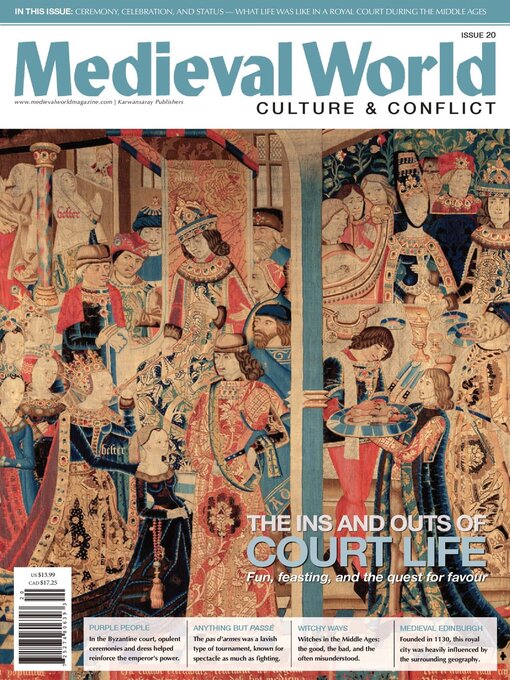
 Issue 20 - 2025
 Issue 19 - 2025
 Issue 18 - 2025
 Issue 17 - 2025
 Issue 16 - 2025
 Issue 15 - 2024
 Issue 14 - 2024
 Issue 13 - 2024
 Issue 12 - 2024
 Issue 11 - 2024
 Issue 10 - 2024
 Issue 9 - 2023
 Issue 8 - 2023
 Issue 7 - 2023
 Issue 6 - 2023
 Issue 5 - 2023
 Issue 4 - 2022
 Issue 3 - 2022
 Issue 2 - 2022
 Issue 1 - 2022
Medieval World: Culture & Conflict picks up where its sister magazines – Ancient Warfare and Ancient History – leave off. The publication features the rich history and material culture of the Middle Ages – broadly conceived geographically and temporally – expanding on the contents of the popular Medieval Warfare magazine. Through well-researched and lavishly illustrated articles, this accessible publication brings to light cultural activities in local and global contexts, historical figures and events, as well as political, religious, economic, and artistic facets of the Middle Ages..
Medieval World Culture & Conflict Magazine
Editorial
Medieval history news and recent discoveries MARGINALIA
The principal burgh of our kingdom MEDIEVAL EDINBURGH • Edinburgh is not located on a river or directly by the sea. Instead, its initial form sat atop a ridge surrounded by marshland and shallow lochs. The site of Edinburgh is so particular that it continued to shape human settlement and preserve architectural heritage up to and even beyond the early modern era.
The risk of fire
When chivalric culture failed KNIGHTS BEHAVING BADLY • We tend to focus on the virtues of knights: bravery, prowess, courtesy, generosity, and the sense of fair play. But what about those who broke the rules and behaved badly. What did chivalric society think about them?
Origins and sources COURTLY CULTURE IN THE MIDDLE AGES • Although they shared the broad rhythms of aristocratic life, medieval courts developed their own distinctive structure, ideals, and rituals. In this issue, we take a look at courtly life and in particular entertainment at the court.
Of love, magic, and chivalry THE ROMANCES OF COURTLY LIFE • Brave knights rescuing beautiful ladies; vicious battles against fearsome beasts; magical swords, rings, gardens, and castles; quests for unattainable objects: all amongst the elements that most commonly come to mind when people today think about the Middle Ages. These images come thanks in part to fairy tales, Disney, and modern fantasy, but their roots stem from one of the most popular genres of literature in medieval Europe: courtly romance.
Byzantine power and ceremony THE COURT OF THE PURPLE BORN • To enter the Great Palace of Constantinople was to step into a living theatre of empire. Marble corridors led to gilded halls; mosaics gleamed under lamplight; fountains played beside courtyards filled with the scent of incense. Yet, beyond the splendour, every gesture, every sound, every costume in the Byzantine court spoke a deeper language, one of hierarchy, ritual, and divine order.
Knights, giants, and unicorns PAS D’ARMES • Tales of mysterious horsemen galloping into court and challenging the great and the good of the realm, incognito warriors fighting for an honourable cause, and solitary knights vanquishing many foes; all are evocative scenes of chivalric literature. In the summer of 1468, such legends came to life when the Knight of the Golden Tree arrived in the city of Bruges. This stranger had been charged by his mistress, The Lady of the Secret Isle, to travel to the lands of Duke Charles the Bold and there, in tournament, test the martial prowess of Burgundian chivalry.
CENTERFOLD: The Enchanted Column
Financing the pas d’armes
Chivalry, power, and spectacle THE COURT OF EDWARD III • The medieval court in England arguably reached its apex during the reign of Edward III (r. 1327–1377), a king who was committed to the visual and material culture of court life. He established a court that was one of the most ambitious and influential in Europe.
Fine cuisine and table manners DINING AT COURT • What made nobles’ tables different from those of the common folks? First, there was the quantity of food served to the guests, which signaled...